



Cannabinoid Sleep Formulation Parameters
Oral cannabinoid formulations designed for night-time use generally follow specific structural parameters to ensure consistency, stability, and predictable absorption.
-
Serving Size & Cannabinoid Ratio: Night-time formulations often combine low doses of Delta-9-THC ($2.5\text{ mg}$ to $5\text{ mg}$) with minor cannabinoids like Cannabinol (CBN, $5\text{ mg}$ to $10\text{ mg}$) or Cannabidiol (CBD). Minor cannabinoids are included to leverage potential synergistic interactions, often referred to as the entourage effect.
-
Delivery Matrix: Gelatin or pectin-based gummy matrices serve as lipid-soluble carrier systems. Because cannabinoids are lipophilic, they require fatty acids or emulsifiers (such as sunflower lecithin) within the matrix to improve bioavailability during digestion.
-
Pharmacokinetics: Oral administration undergoes first-pass hepatic metabolism. Delta-9-THC is converted in the liver by cytochrome P450 enzymes into 11-hydroxy-THC ($11\text{-OH-THC}$), a metabolite that crosses the blood-brain barrier more efficiently and exhibits a longer elimination half-life ($4\text{ to }8\text{ hours}$) compared to inhaled cannabis.
-
Onset & Duration: Onset typically ranges between $30\text{ and }90\text{ minutes}$, dictated by gastric emptying rates, with peak plasma concentrations occurring around $2\text{ to }4\text{ hours}$ post-ingestion.
The Physiology of THC and Sleep Architecture
Understanding how orally ingested cannabinoids interact with sleep requires examining the endocannabinoid system (ECS) and its influence on circadian sleep-wake cycles.
1. Interaction with the Endocannabinoid System
The human body regulates sleep through the homeostatic sleep drive and circadian rhythms. Endogenous cannabinoids, such as anandamide (AEA), bind to $CB_1$ receptors located heavily in the central nervous system, including the basal forebrain and hypothalamus—regions responsible for sleep regulation. Exogenous Delta-9-THC acts as a partial agonist at these $CB_1$ receptors, mimicking some functions of anandamide to modulate neurotransmitter release (such as GABA and glutamate).
2. Impact on Sleep Stages
Research into how cannabinoids alter sleep architecture shows distinct effects across different sleep phases:
-
Sleep Onset Latency: Studies suggest that low-to-moderate doses of THC can reduce sleep latency (the time it takes to fall asleep). This is primarily driven by its acute sedating properties and reduction of central nervous system arousal.
-
Slow-Wave Sleep (Deep Sleep): Acute administration of THC has been observed to increase time spent in Stage 3 non-REM (N3) slow-wave sleep. Deep sleep is critical for physical recovery, tissue repair, and metabolic clearance in the brain.
-
REM Sleep Suppression: One of the most consistent findings in cannabinoid research is the reduction of Rapid Eye Movement (REM) sleep and REM density. Because dreaming predominantly occurs during REM, users frequently report a decrease in dream recall. However, long-term REM suppression can lead to a “REM rebound” effect—characterized by vivid dreams and sleep disruption—if usage is abruptly stopped after chronic consumption.
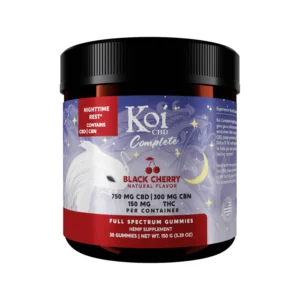
Be the first to review “Black Cherry THC Sleep Gummies With THC”
Related products







Reviews
There are no reviews yet.